



Monitoring vs. Control: What Energy Platforms Actually Do
Every energy platform on the market will tell you it does more than monitoring.
Most of them are describing the same four capabilities in different language, and the difference between them is not a feature list. It is whether the system can act, how far it can act without asking, and what happens when it is wrong.
Here is the honest version of that spectrum, what each tier is worth, and which one your facility actually needs. Hint: it’s maybe not the most "advanced" looking one.
The four tiers
Nearly every platform in this category sits at one of four levels. The vocabulary varies by vendor. The underlying architecture does not.
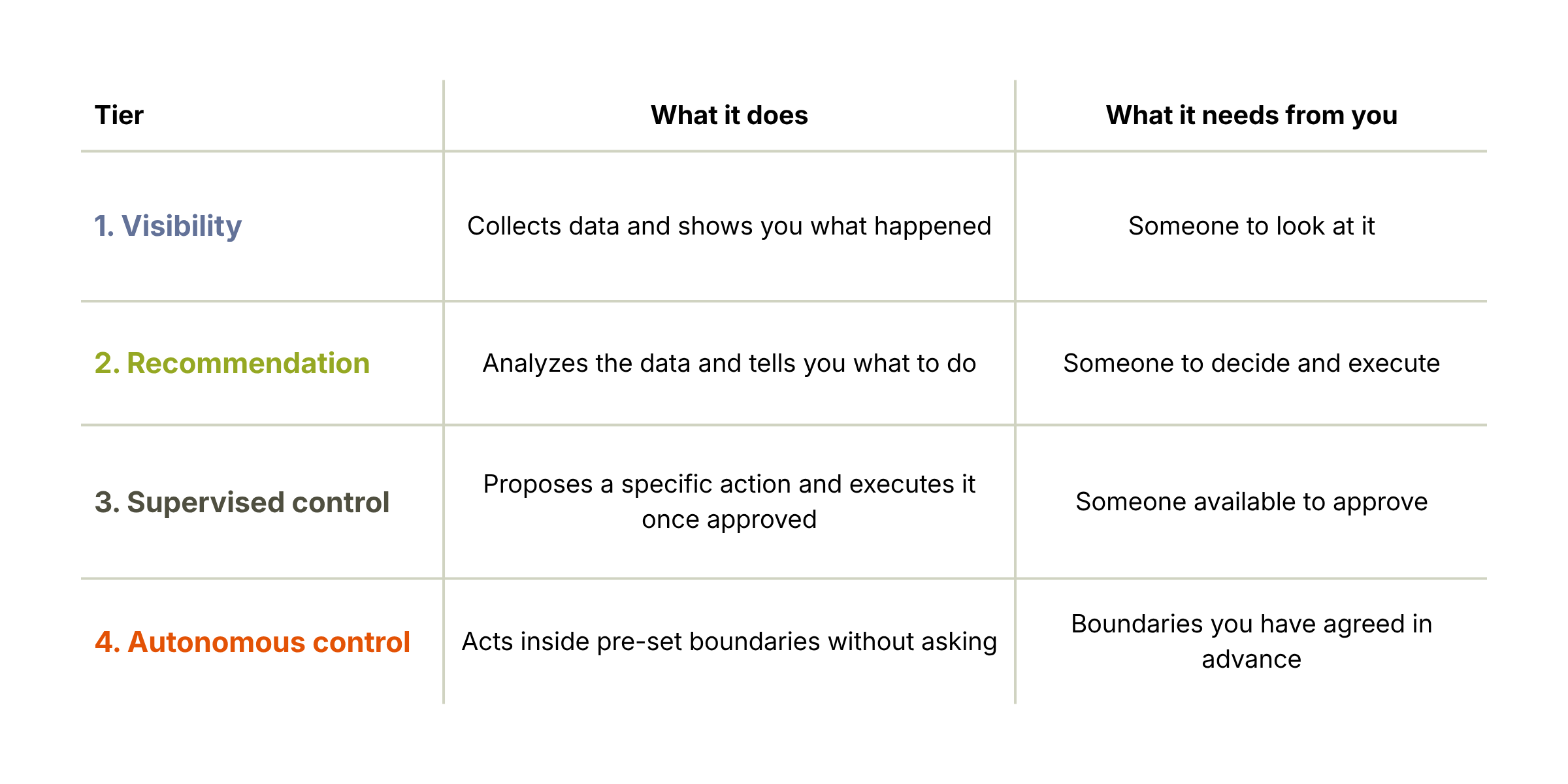
As each tier takes on more responsibility, your role shifts from watching and approving to simply setting the rules in advance.
The jump that matters is between tiers 2 and 3. Everything below it produces information. Everything above it produces a changed state in your facility.
Those are different products with different risk profiles, and a lot of category language is built to blur the line.
What each tier is actually worth
Visibility is worth more than it gets credit for, and less than it is usually sold for.
You cannot manage a cost you cannot see, and most industrial facilities genuinely cannot see theirs: energy data sits in the utility portal, production data sits in the WMS, and nobody has put them in the same sentence. Fixing that is real work with real returns, particularly the first time someone normalizes energy against throughput rather than square footage.
But visibility only pays out through a human who has time to look. That is the honest limitation. A dashboard that surfaces a 6% efficiency drift on a compressor has done its job; if nobody opens it for three weeks, the drift ran for three weeks.
Recommendation narrows the problem but does not remove the person.
A system that says "your suction pressure setpoint is 4 psi lower than it needs to be" is more useful than one that shows you a pressure chart. It has done the diagnosis, but not the change. In most facilities the gap between knowing and doing is measured in weeks, because the person who knows is not the person with access, and the change has to survive a shift handover.
Supervised control is the right answer for more facilities than admit it.
The system proposes, a human approves, the system executes. This is the tier most operations teams are actually comfortable with, and it captures the majority of available savings on anything that moves slowly (setpoints, staging, scheduling, blast freezer cycles). If your cost problem unfolds over hours or days, supervised control will solve it, and you keep a person in the loop.
There's a version of this that isn't about risk tolerance, it's about ownership. Handing over manual execution is a relief. Handing over the ability to say what happened in your facility and why is a different decision entirely, and most operators feel the difference even when they can't articulate it. Supervised control lets you give up the first without giving up the second.
Autonomous control exists for one reason: some windows are too short for a human.
That is the whole argument. Operators aren’t slow or unreliable. It’s that certain markets price electricity faster than any approval chain can reasonably move.
In ERCOT, real-time prices settle every five minutes and can move more than 300x. A coincident peak interval is set in fifteen minutes. If your response requires an alert, a phone call, a judgment about whether the disruption is worth it, and then an execution, the interval closed while you were on the phone. Not because anyone did anything wrong.
Autonomous control is not a better version of supervised control. It is a narrow answer to a narrow problem: cost events that resolve faster than a decision can be made.
When is autonomous control the wrong answer?
- When your cost problem isn't time-bound.
If you are on a flat commercial rate with no demand charge and no real-time exposure, there is nothing for an autonomous system to catch. Your savings are in setpoints and equipment scheduling, and supervised control will get you there with less to explain internally.
- When the process cannot tolerate the shed.
Some production runs cannot be interrupted at any price. Some product cannot ride through a curtailment window. If the honest answer is "we would never actually shed that load," then autonomous curtailment on that load is theatre.
- When your instrumentation isn't there yet.
Autonomous action against bad data is worse than no action. If a site has three meters and no product-temperature sensing, the sequence is instrumentation first, control second. A vendor willing to skip that step is telling you something.
- When the governance isn't settled.
Somebody has to own the boundaries — what can be shed, at what price, for how long, and who changes that. If that decision has no owner, the system will eventually take an action nobody agreed to, and the program will end that week.
Most facilities running autonomous control run it on a subset of load, with the rest supervised or untouched. That is not a compromise. That is the design working correctly.
What this looked like at Genan
Genan is the world's largest mechanical tire recycler, operating an energy-intensive facility in Houston, located inside the most volatile electricity market in the United States.
During the 2021 Texas freeze they were hit with hundreds of thousands of dollars in unexpected energy costs, and came within a hair of $3 million in avoidable charges. The cause was not a missing dashboard. They could see the prices. The curtailment decision was made by a person, and it was made late, because the market moved faster than the decision could.
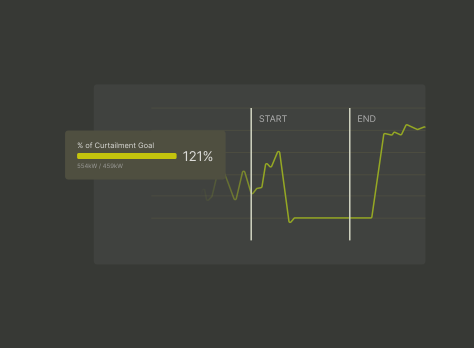
What changed was the removal of that decision from the critical path. The system now receives real-time rate signals directly from the grid operator and curtails against thresholds agreed in advance:
- Selected processes shut down at $120–150/MWh
- Full facility shutdown at $350/MWh
Those numbers were set once, by people who understood the production tradeoff, in a room, with time to think. The system does not decide whether shedding is worth it. It executes a decision that was already made.
On July 9, 2022, prices spiked to $4,000/MWh. The facility was already down. That single day saved more than $20,000. Payback on the whole system came in under four months.
"I've saved hundreds of thousands, making it possible for me to produce in a very volatile energy market." -Michael Agerkilde, COO, Genan
The point of the example is not the savings figure. It is the boundary: a fixed threshold, agreed in advance, executed without discussion. That is what tier 4 means in practice, and it is far less dramatic than the word "autonomous" suggests.
How the control pathway is scoped
This is the part most vendors leave vague, so it is worth being precise about our own architecture and why we built it this way.
Our standard data integration is passive and read-only. It receives sensor data, meter readings, and equipment telemetry. It has no pathway to send commands to production systems, refrigeration equipment, or building controls. That is not a permission setting. It is how the integration is built, and it is why we can deploy into FDA-regulated sites and facilities with strict IT/OT segmentation.
Control is a separate, explicitly commissioned deployment. It does not come switched off inside the standard integration waiting to be enabled. It is scoped during implementation to named loads, with agreed thresholds and a documented owner, and it is engineered as its own pathway. A site running our platform for visibility has no dormant write access to be misconfigured or compromised into.
The reason that separation matters goes beyond security. It's the same accountability question that runs through every tier above: if a system can act, someone has to be able to check what it did. Bundling control into the base integration doesn't just widen the attack surface, it blurs the line between what the platform observed and what it changed, which makes it harder to answer a simple question later: did this action actually work? Keeping the pathways separate keeps that answer traceable, at any tier, on any site.
Genan is a control deployment. Most of our sites are not, and did not need to be.
The practical consequence is that adding energy intelligence and granting control authority are two different decisions, made at two different times, with two different reviews. Your IT team can evaluate the first without being asked to approve the second, which is usually the reason these projects stall.
Ask any vendor whether the same is true of theirs. If control is a flag on an existing connection, the security question you are answering is a different and larger one than you think.
How to tell which tier you're being offered
Ask your vendor these five questions:
- Can the platform change the state of my equipment, or only read from it? If it can act, ask whether that pathway is scoped to named loads and commissioned separately, or whether it ships enabled across the connection.
- What is the fastest event this system can respond to without a human? If the answer involves a notification, it is tier 2, whatever the marketing says.
- Who sets the boundaries, and how are they changed? There should be a named owner and a documented process.
- What happens when connectivity drops? The failure behavior should be defined, safe, and testable — not a shrug.
- What did the savings number use as a denominator? A percentage reduction with no throughput figure behind it is not a result you can verify. Ask for energy per unit of output.
Most buyers ask about encryption and integrations, which are answerable and rarely decisive. These five determine what you are actually buying.
What the brain can't tell you about itself
Every vendor in this category, including the ones with real automation, will eventually use some version of the word "brain." The problem with that framing isn't the ambition. It's that a brain making decisions for you creates a new question nobody's framing answers: how do you know the decisions were good ones?
That's not a rhetorical flourish. It's an attribution problem. If your control system's actions are commingled with weather, occupancy, seasonal load, and half a dozen other variables, "the brain saved you money" is a claim you have to take on faith. And faith is an expensive thing to build a capital decision on.
This is why tiers 1 through 4 are not actually a ladder toward a single destination. Reporting and verification aren't a lesser version of automation, waiting to be replaced. They're the layer that holds every other tier accountable, including the automated ones. A system that acts without a clean way to prove what its actions were worth isn't more advanced than one that doesn't act. It's just harder to check.
The facilities that get this right aren't the ones chasing the top tier. They're the ones who can answer, for any tier they're running, what did this actually do, and how do we know.
The short version
Monitoring is not a failure state. It is tier one of four, it is genuinely valuable, and for a meaningful share of facilities it is the correct place to stop for now.
But if your exposure lives in fifteen-minute intervals, no amount of visibility will reach it. Not because your team isn't good. Because the window closes faster than a decision can be made, so the only way through that is to make the decision in advance and let the system carry it out.
See what controls should look like at your facility →