





Setpoint Optimization in Cold Storage
Operational drift is normal, but your facility doesn’t need to keep paying for it.
One of the most valuable energy savings opportunities in cold storage requires no new equipment, no production downtime, and often takes less than 30 minutes to implement. Yet it goes untouched in the majority of facilities we assess, not because it's difficult, but because it's invisible without the right data.
What setpoints are, and why they drift
A setpoint is a target operating parameter: the temperature a cold room should maintain, the suction pressure a compressor runs at, the duration a blast freezer cycle runs before shutdown. Every refrigeration system is built around a defined set of these parameters. When they're tuned correctly, the system operates as designed. When they're off, the system works harder than it needs to and your energy bills reflect it.
The drift is rarely dramatic. It doesn't happen because something broke. It happens because systems are living things, shaped by the constant negotiation between equipment performance, operational demands, and accumulated adjustments over time. A blast freezer setpoint gets bumped up a few degrees during a peak season rush and never gets walked back. A suction pressure threshold is dialed in conservatively during commissioning and stays there for years. A temperature band gets widened to reduce alarm fatigue.
Each individual change seems reasonable in the moment. Over time, they compound. What started as a well-tuned system gradually drifts away from optimal. Without continuous monitoring, there's no reliable way to detect it. This is operational drift: the natural accumulation of small, rational changes that, in aggregate, quietly erode efficiency.
The most common setpoint problems
Suction pressure
Suction pressure is one of the most energy-sensitive parameters in a refrigeration system. Running at too low a suction pressure forces compressors to work significantly harder to move the same amount of heat. This is where we most frequently find the largest savings opportunities. And it’s often because the setpoint was configured conservatively during installation and was never revisited as operating conditions evolved.
Blast freezer runtime
Blast freezers are workhorses, but they're often left running well past the point of diminishing returns. If a cycle is programmed to run four hours but product reaches target temperature in three, that extra hour is pure waste. Without load monitoring, there's no way to know where the actual threshold is, and conservative operators err toward running longer, not shorter.
Temperature bands
Temperature setpoints in cold storage often have unnecessarily wide bands: running colder than product specs require, or maintaining ranges that made sense for a previous tenant or product mix. Every extra degree of cooling costs energy. Tightening bands to match actual product requirements is one of the simplest optimization moves available, and one of the most commonly overlooked.
Why facilities miss setpoint drift without monitoring
The challenge isn't awareness. Most facilities managers know setpoints matter. The challenge is visibility. In a large facility with dozens of refrigeration circuits, blast cells, and compressor banks, there's no practical way to manually track whether each parameter is optimized. Maintenance teams respond to failures, not inefficiencies. Operators manage production, not energy performance. Audits happen infrequently and capture a snapshot in time.
The result: suboptimal setpoints can persist for months or years, quietly consuming energy at every hour of every operating day, because there's no system in place to flag the deviation or quantify the cost.
This is the gap that energy monitoring closes. When you have continuous visibility into operational parameters alongside energy consumption, setpoint drift becomes visible as a pattern, not just a possibility. You can see when a compressor's energy draw changes without a corresponding change in cooling load, or when a blast freezer's runtime per cycle has been trending upward. The data tells you where to look.
$240,000 from one setpoint change
Case Study: Suction Pressure Optimization at a Cold Storage Facility
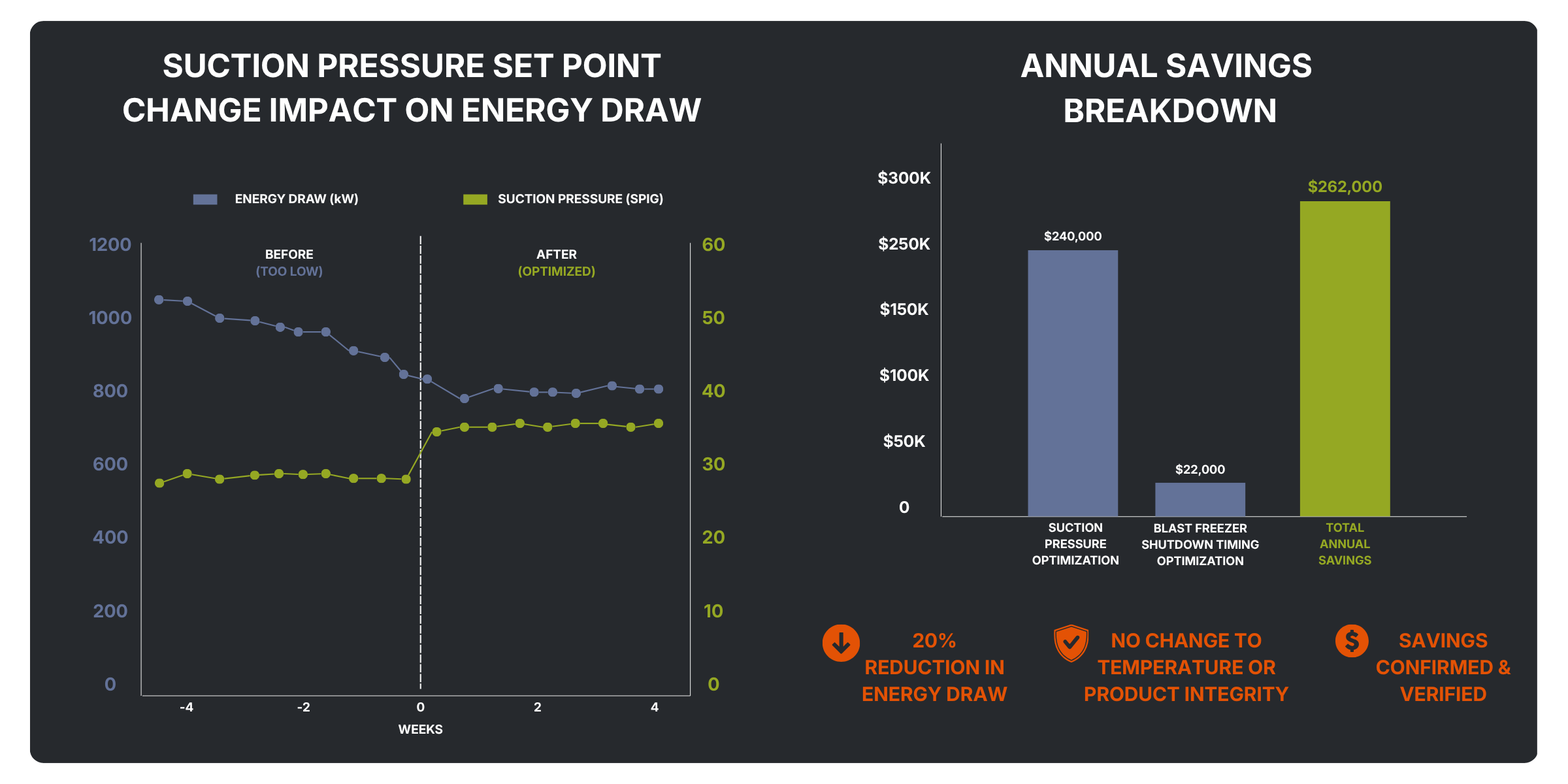
During a site assessment powered by Ndustrial, our team identified that the facility's primary refrigeration system was running at a suction pressure significantly below the level the system could sustain without compromising cooling performance. The setpoint had been configured conservatively during commissioning and had never been revisited.
Adjusting the suction pressure setpoint to a more appropriate level. It’s a change that required no hardware modifications and less than a day to implement and verify, but produced the following results:
- $240,000 in annualized energy savings / roughly 20% of the facility's total energy spend
- No change to temperature performance or product integrity
- Savings confirmed and verified through post-change monitoring
The additional $22,000 in annual savings from blast freezer shutdown timing optimization came from the same assessment. In that case, runtime data showed that product was consistently reaching target temperature well before cycle completion. Adjusting the shutdown trigger eliminated that trailing runtime across every cycle, every day.
These weren't unusual findings. They're representative of what turns up when facilities have the monitoring infrastructure to surface what's actually happening, rather than relying on manual checks or assuming the system is running as configured.
How to identify setpoint optimization opportunities
You don't need to conduct a full energy audit to find setpoint issues. The starting point is asking the right questions against real operational data:
- When was each setpoint last reviewed? Was it during commissioning, or has it been revisited since?
- Do current setpoints reflect actual product requirements, or legacy configurations?
- Is suction pressure monitored continuously, or only checked during service visits?
- Are blast freezer runtimes correlated against load data, or set as fixed time intervals?
- Are temperature bands tighter than they need to be for the products currently in the facility?
- Has energy consumption trended up without a corresponding change in throughput or occupancy?
If you can't answer these questions with confidence, that itself is the finding. A facility operating on unreviewed setpoints and without continuous parameter monitoring is almost certainly leaving savings on the table. The question is how much.
Nsight is designed to surface exactly these opportunities — identifying deviation patterns, flagging inefficiencies against benchmark performance, and quantifying the savings potential before you commit to any change. For a deeper look at how energy intensity benchmarking supports this kind of analysis, see our post on Energy Intensity in Cold Storage.
What to expect: timeline, disruption, and verification
Setpoint optimization is notably low-friction compared to other energy improvement projects. There's no equipment to procure, no contractors to schedule, no production windows to coordinate around. In most cases, the workflow looks like this:
- Review: Flag parameters with deviation patterns or high savings potential using Nsight dashboards
- Validate: Confirm proposed changes are compatible with current product mix, load profiles, and equipment capacity
- Implement: Make the setpoint adjustment; typically under 30 minutes per parameter, most completed during normal operating hours with no downtime
- Verify: Monitor post-change performance to confirm energy reduction against pre-change baseline and verify temperature performance is maintained
The verification step is often underestimated in value. Being able to demonstrate measurable savings from a specific operational change with data is what builds internal confidence and unlocks the next round of optimization. It's also what creates the foundation for more programmatic energy management at the corporate level. For facilities teams looking to communicate impact upward, verified case studies carry far more weight than projected estimates.
Setpoint optimization is frequently the best first project for facilities beginning an energy management program. And not because it's the only opportunity, but because it produces quick, verifiable wins with no capital risk. Those early wins create the organizational buy-in that makes larger efficiency projects possible. For more on related operational improvements, see our posts on Blast Freezer Optimization and Temperature Monitoring in Cold Storage.
See what your setpoints are actually doing.
Most facilities have optimization opportunities they can't see yet. A site assessment gives you the data to find them and the verified savings to act on them.