




The Price of a Kilowatt-Hour Now Depends on the Hour (Georgia Is the Sharpest Example!)
For most of the last decade, an industrial operator could treat electricity as a fixed cost. You signed up for a rate, you paid the bill, and the number moved slowly. That assumption is breaking. Across the U.S., the price of power is becoming a moving target — and in Georgia, the swings are wide enough that the hour you run a compressor can matter as much as how efficiently it runs.
Electricity pricing is splitting apart by region, and by the hour
Wholesale power prices jumped roughly 40% year-over-year in the first half of 2025, averaging around $48/MWh, and the EIA expects the load-weighted regional average to climb another 8.5% to about $51/MWh in 2026. But the headline average hides the real story, which is variability. Regional wholesale prices already range from roughly $30/MWh in ERCOT to about $55/MWh in the Northwest and New England, and the largest jumps (30% to 35%) are landing in the Southwest and California. Natural gas sets the marginal price of electricity in most regions during most hours, so as Henry Hub climbed 56% in 2025 and is forecast to push toward $4.00/MMBtu in 2026, the price floor moves with it.
The bigger shift is intraday. Markets like ERCOT saw real-time prices blow past $127/MWh during a single May heatwave. When demand spikes and gas plants set the price, the cost of a kilowatt-hour at 5 p.m. can be many times its cost at 5 a.m. The annual average barely captures that, but your bill does.
Georgia's Real-Time Pricing rate is the variability story in its rawest form
Georgia Power runs the oldest and largest Real-Time Pricing program in the country. Launched in 1991, it had close to a third of the utility's demand on RTP by 2000. If you operate an industrial facility in Georgia with a monthly peak above 250 kW, there's a strong chance you're already on it — RTP-DA for day-ahead pricing, RTP-HA for hour-ahead at larger peaks.
Here's what that rate actually looks like:
Against Georgia Power's 2025 day-ahead hourly prices over 8,760 hours of real data, the mean price was about $0.057/kWh. That sounds cheap, and most hours of the year it is. But the peak hit $4.14/kWh. In July 2025 alone, there were 126 hours priced above $0.15/kWh. Summer heatwaves drove repeated spikes above $2.80/kWh, and a winter storm pushed prices to $3.37/kWh. The cheap average and the brutal peaks are the same rate — the difference is entirely which hours you're consuming.
And the spikes aren't holding steady, they're escalating. Pull the day-ahead price history across our portfolio and the summer pattern is unmistakable: the worst hour of each summer has climbed from $0.69/kWh in 2020 to $4.14/kWh in 2025, roughly a 6× increase in five years, while the typical summer hour barely moved off the floor at $0.03–$0.15/kWh. Summers aren't getting expensive on average. They're getting spikier and the extremes are growing every year.
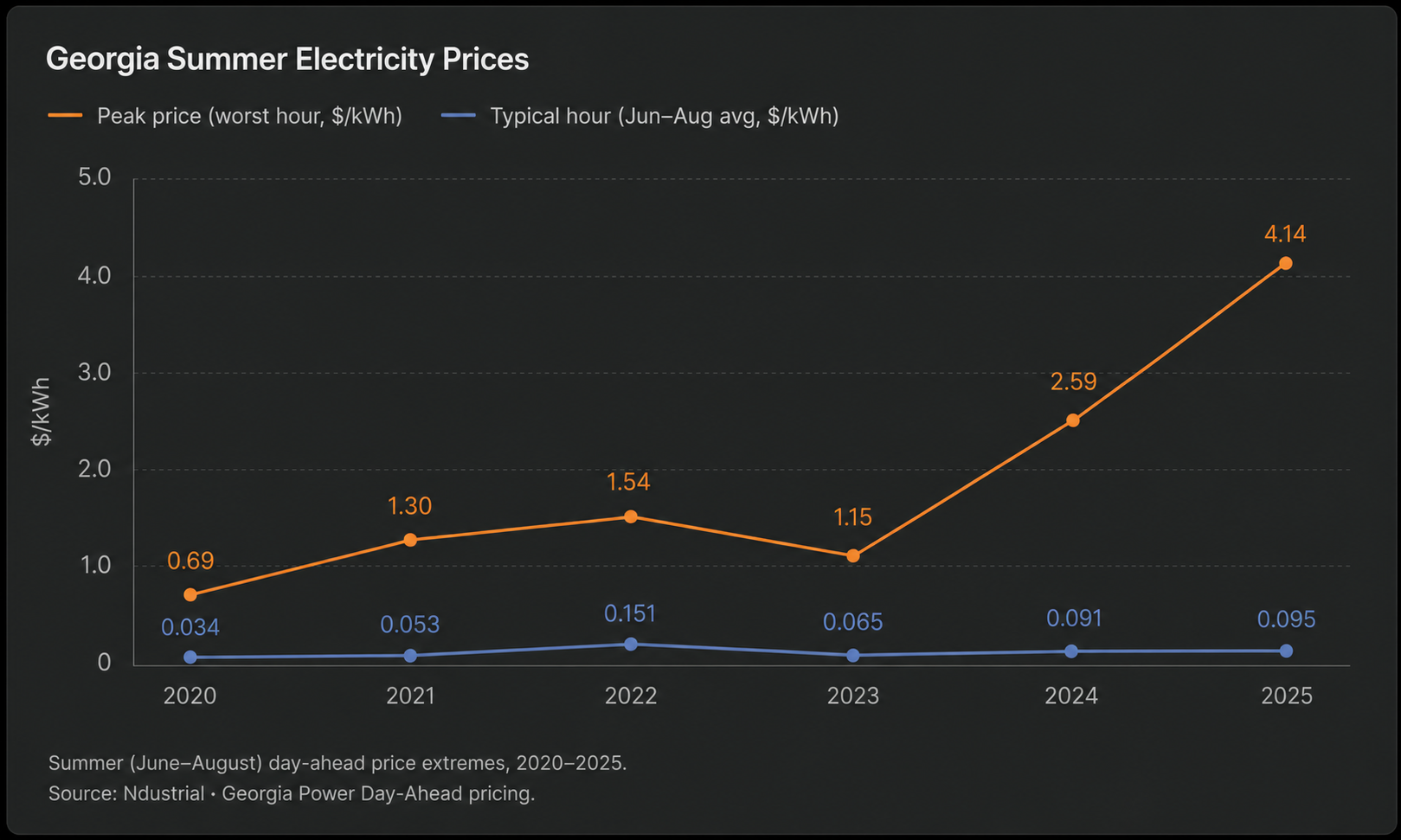
The worst hour each summer keeps setting new records; the typical hour stays cheap.
Source: Ndustrial · Georgia Power Day-Ahead pricing.
The exposure is real, but so is the upside
The trap with RTP is treating it as something to endure. A facility that runs flat through a $4/kWh afternoon is leaving real money on the table every summer. A facility that can shift even a fraction of its load (pre-cooling freezers, resequencing a production batch, staging staffing around the price curve) turns those same hours into savings.
Cold storage is especially well positioned. A freezer is a thermal battery: pre-cool it during cheap overnight hours and it coasts through the expensive afternoon with the compressors backed off. Food processing has similar slack in batch timing. The levers are already in your operation — the hard part is knowing the price ahead of time and acting on it consistently, every day, without a person watching the ticker.
That's the gap Ndustrial closes.
How it works
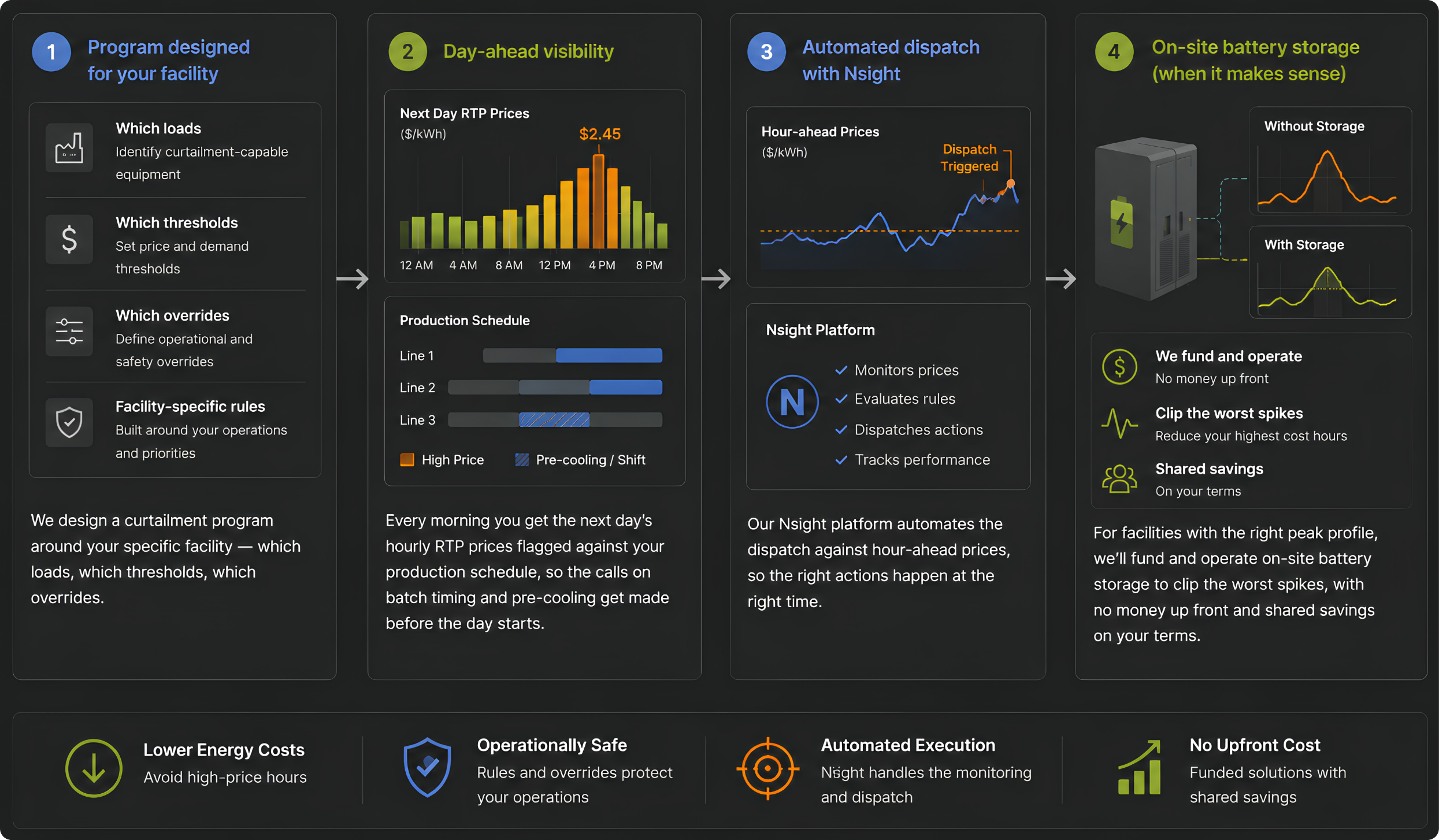
Every morning you get the next day's hourly RTP prices flagged against your production schedule, so the calls on batch timing and pre-cooling get made before the day starts. We then design a curtailment program around your specific facility - which loads, which thresholds, which overrides - and our Nsight platform automates the dispatch against hour-ahead prices. For facilities with the right peak profile, we'll fund and operate on-site battery storage to clip the worst spikes, with no money up front and shared savings on your terms.
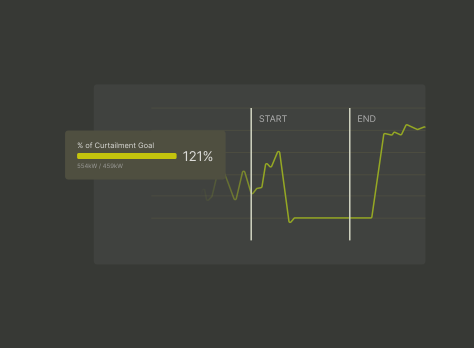
The results show up where it counts. One cold storage operator in our portfolio went net-negative during the hours that mattered this past summer — generating credits instead of paying spikes — and turned what used to be their worst week of the year into one of their best. Across triggered events that season: roughly $31,800 in savings, $8,800 from a single peak event, with about 35% average load curtailment.
See your own number
The variability isn't going away. Gas prices, summer demand, and grid stress all point the same direction, and rates like Georgia's RTP pass that volatility straight through to the meter. The question for any operator on the rate isn't whether the spikes are coming — it's whether you're positioned to profit from them or pay for them.
We built a calculator that models your facility against Georgia Power's actual 2025 hourly prices. Plug in your facility type, peak demand, and how much load you can flex, and it shows what you could have saved last year — and where each curtailment opportunity sits on the real price curve.
Run your estimate at marketing.ndustrial.io/rtp-calculator.
Or send us your last 12 months of interval data and we'll model your real meter against 2025 prices and walk you through it on a 15-minute call.