




Coincident Peak Explained
How One Hour a Month Can Cost You $40,000
(and How to Avoid It)
Your utility bill might be controlled by a single 15-minute window each month. Most facility managers don't know which window it is until the bill arrives.
Coincident peak is the moment when your facility's power consumption coincides with the period of maximum demand across the entire grid. That overlap, which might last just one hour, can determine a significant portion of what you pay for electricity for the next 12 months. Understanding how it works is the first step to controlling it.
What Is Coincident Peak and Why Does It Exist?
Utilities and grid operators must maintain enough generation capacity to serve every customer at once, even during the highest-demand moments of the year. Building and maintaining that capacity is expensive. Coincident peak programs are how utilities pass a share of those infrastructure costs back to large energy users, based on how much those users contributed to the problem.
The logic is straightforward: if your facility draws significant power during the grid's peak moment, you're part of why expensive capacity must exist. The more load you place on the grid at that moment, the more capacity costs get allocated to your account.
Programs vary by market. In ERCOT (Texas), the 4CP mechanism identifies the four highest peak demand intervals of the summer, one 15-minute window per month from June through September. Your average demand during those four intervals sets your Transmission Cost Allocation for the entire following year. In PJM (covering Pennsylvania, New Jersey, Maryland, and beyond), the 5CP program targets five peak hours across the summer. Other utilities identify a single annual peak or use a monthly coincident peak calculation. The structure differs, but the implication is the same: a brief window of high demand can reshape your bills for a year.
How Utilities Set Demand Charges Based on Peak Hour
Demand charges are calculated based on peak kilowatts consumed, not total kilowatt-hours. This distinction matters enormously.
Energy efficiency programs focused on reducing consumption (kWh) will do little to reduce coincident peak charges. What matters is how many kilowatts your facility draws during that specific peak window.
Consider a typical rate structure: during normal periods, a facility might pay $5 per kW. During a coincident peak interval, that rate can jump to $21 per kW or higher. For a facility with a 1,866 kW load, the math looks like this:
Without coincident peak management: 1,866 kW x $21/kW = $39,186
With load reduction during the peak window: 183 kW x $21/kW = $3,843
That's a difference of $35,343 from managing a single hour. Across four summer peak windows and applied to the following year's transmission cost allocation, the annual impact can reach hundreds of thousands of dollars for large facilities.
Coincident peak charges typically represent 30 to 70 percent of a large energy user's monthly electric bill. It is often the single highest-leverage line item on the utility statement, and most facility teams are not actively managing it.
Why Most Facilities Can't Avoid It Without Advance Warning
The core challenge is uncertainty. You don't know which hour will be the coincident peak until after it happens. By the time your bill reflects the charge, the opportunity to avoid it is gone.
Traditional approaches fall short for several reasons. Static curtailment schedules reduce some demand but rarely align with actual peak windows. General weather forecasts can suggest high-demand days but don't identify the specific hour when grid-wide demand will crest. Manual operator decisions are too slow and too variable to execute consistent curtailments when timing matters down to 15-minute intervals.
The grid is also harder to predict than it used to be. Solar generation drives wholesale prices negative during daytime hours, then prices spike sharply in the early evening as solar ramps down and more expensive generation comes online. Large flexible loads like cryptocurrency mining can curtail rapidly, shifting the peak in unpredictable ways. Extreme weather events add further volatility: Hurricane Beryl's impact on Texas in 2024 significantly altered the timing and magnitude of the July peak compared to prior years.
Without predictive analytics built for these dynamics, facilities are essentially guessing.
How 7-Day Forecasting Changes the Equation
Accurate advance warning converts coincident peak from an uncontrollable cost into a manageable one.
Ndustrial's Coincident Peak application monitors local grid conditions and generates a 7-day forecast with probability-weighted predictions of when peak intervals are likely to occur. Customers receive email and text alerts with advance notice of predicted peak windows, giving operations teams time to prepare rather than react.
The system achieves over 90% accuracy on 2-hour prediction windows, roughly twice as accurate as standard utility alerts. In some cases, accuracy on 1-hour windows extends up to 7 days in advance. That lead time is what separates facilities that successfully curtail from those that curtail at the wrong time, starting too late or powering back up too early and erasing their savings.
Because the system is calibrated to each customer's operational context and risk tolerance, it minimizes unnecessary curtailment calls. Production is the priority, and excess curtailment events that disrupt operations without corresponding savings are a problem the platform is specifically designed to avoid.
Three Ways to Respond: Pre-Cool, Shift Loads, Dispatch On-Site Generation
Receiving an accurate alert is only valuable if the facility can act on it. There are three primary response strategies, and the right mix depends on the operation.
- Pre-cooling works especially well for cold chain and refrigerated facilities. In the hours before a predicted peak window, compressors run harder to bring temperatures down beyond their normal setpoints. During the peak interval itself, refrigeration loads can be reduced or temporarily suspended while temperatures remain within safe range. The facility effectively borrows cold capacity from the future to reduce demand at the moment it's most expensive.
- Load shifting moves discretionary energy use away from predicted peak windows. This can include shifting production schedules so energy-intensive processes run during off-peak hours, staggering equipment start times, temporarily adjusting HVAC setpoints, curtailing non-critical motors or pumps, and coordinating lighting or compressed air systems. The key is knowing in advance which loads can be shifted without impacting throughput or product quality.
- On-site generation dispatch activates backup generators, battery storage, or other distributed energy resources during peak windows to reduce grid draw. Facilities with on-site assets can dramatically cut their coincident peak exposure during the critical interval without curtailing production at all. Battery Energy Storage as a Service (BESSaaS) models now allow facilities to access these capabilities without significant upfront capital.
Execution discipline matters as much as prediction accuracy. Curtailing 15 minutes too late, or powering back up before the peak clears, can erase most of the savings from an otherwise well-executed event.
Real Results: $45,000 Saved Over 4 Months
The financial impact of effective coincident peak management is well-documented across Ndustrial's customer base.
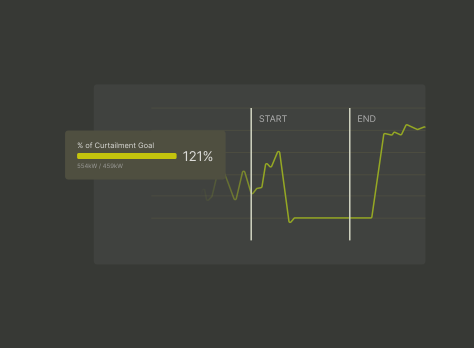
One manufacturing customer reduced its load from 1,866 kW to 183 kW during a peak interval, cutting that month's demand charge from $39,186 to $3,843. Over a four-month period, the same facility accumulated more than $45,000 in savings: "Coincident Peak has saved us over $45,000 over the past 4 months. Without the advanced warning, we would not have been able to realize these savings."
A cold storage customer in Tar Heel, North Carolina reduced its total electric bill by more than 15% in a single year by curtailing during coincident peak intervals. A Lineage Logistics facility cut its monthly load by 1,800 kW during peak windows, saving an average of $30,060 per month at their applicable rate.
The pattern across these outcomes is consistent: the savings come from acting on accurate, advance intelligence rather than reacting after the fact.
The Bottom Line
Coincident peak charges are one of the most significant and least managed costs in industrial energy. They're determined by a handful of hours each year, they're predictable with the right tools, and the actions required to avoid them are available to any facility with flexible loads.
The facilities that manage this well aren't necessarily the ones with the lowest total energy consumption. They're the ones that know which hour matters and are ready when it arrives.
See how coincident peak prediction works for your facility.